The following data is extracted from GenericsWeb Pipeline Patent Intelligence and is intended to give a brief outline of factors affecting the potential launch of generic Telmisartan equivalents of Boehringer Ingelheim’s blockbuster angiotensin II receptor antagonist, Micardis®. Global Micardis® sales generated €1.623 billion in 2012.
General information
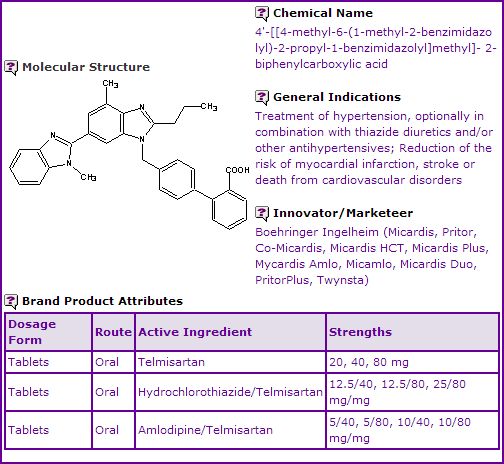
Telmisartan is currently available as oral tablets in 20, 40, and 80 mg strengths for use in the treatment of hypertension. It is also marketed as Micardis® HCT which is a fixed dose combination with Hydrochlorothiazide (HCTZ) in 40/12.5, 80/12.5, 80/25 mg/mg strengths, and Twynsta® its fixed dose combination with Amlodipine in 40/5, 80/5, 40/10, 80/10 mg/mg strengths. In 2009, Boehringer Ingelheim (Boehringer) gained approval to extend the market authorised indication of the Telmisartan 80 mg strength to include reducing the risk of myocardial infarction, stroke or death from cardiovascular disorders. The Telmisartan molecule was discovered and developed by Boehringer, and was launched in Europe and the US in 1998. Boehringer has co-marketing agreements with Bayer Schering Pharma and GlaxoSmithKline in certain countries.
Figure 1: General Information table for Telmisartan
INN Constraint Comment
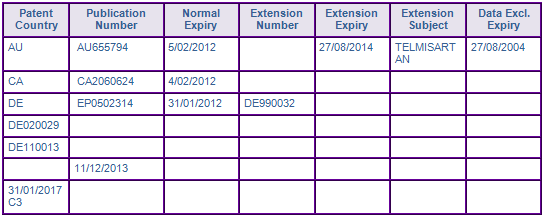
Whilst patent protection for Telmisartan molecule, DE4103492A, has expired in Canada, it is still in force in the US until January 2014, receiving the longer term based on 17 years from the issue date for patents filed prior to June 8 1995. The equivalent European patent, EP0502314 (‘314), has been extended by SPC in France, Germany, Spain and the UK until December 2013 (see Figure 3).
Boehringer, seeking to protect its Telmisartan franchise, has also filed SPC applications for its Telmisartan-HCTZ and Telmisartan-Amlodipine products, for the basic patent ‘314, in France, Germany, Spain and the UK, potentially extending protection until January 2017 (see Figure 3). GenericsWeb’s proprietary SPC analyser has identified the basic patent as a ‘C3’ category, suggesting the claims of the basic patent do not protect the combinations and therefore the SPC may be invalid. The response by the national IPOs in respect to the invalidity of SPCs for the Telmisartan combinations has varied. The French SPC application (FR02C0028) for Telmisartan-HCTZ was initially rejected by the Institut National de la Propriété Industrielle (INPI) in December 2010, finding the claims of the basic patent did not protect a medicine comprising Telmisartan in association with HCTZ. The Paris Court of Appeal upheld INPI’s decision in June 2012, denying Boehringer’s request for appeal. Similarly, on June 2012, the Juzgado de lo Mercantil de Pamplona (the Court) held the Spanish SPC (C20020018) for Telmisartan-HCTZ invalid following a revocation suit filed by Cinfa and Actavis against Boehringer in April 2010. The Court’s decision relied on the ECJ’s findings in the ‘Medeva’ decision relating to SPCs for combination products, which concluded that to satisfy article 3(a) of SPC regulation 469/2009 the wording of the claims of the basic patent had to specify all active ingredients. Therefore, the Court found the SPC to be invalid on the grounds of article 15.1(a) in regard to 3(a), finding ‘314 did not specify a composition of Telmisartan in association with HCTZ. In February 2013, revocation proceedings were filed in the Bundespatentgericht for the German SPC (DE10299029) for Telmisartan-HCTZ. This raises the question of whether the SPC will prevent a generic Telmisartan-HCTZ product in Germany until conclusion of the revocation proceedings or will generic companies launch their products ‘at risk’ upon expiry of the SPC for Telmisartan, therefore assuming invalidity based on the ‘Medeva’ decision and similar findings by other PTOs and Courts in the matter.
The French (FR11C0008), German (DE122011000013) and Spanish (C201100010) SPCs for the Telmisartan-Amlodipine combination have been withdrawn. However, the UKIPO has granted the SPCs for both combination products (see Figure 3). No litigation proceedings have been detected in the UK. This may be due to amendments, under section 27 of the Patents Act 1977, of the specification for the UK designation of ‘314, in 2004 and 2011. The amendments were in the form of amended claim pages which included a pharmaceutical composition comprising HCTZ or a calcium channel blocker.
Patents in the family with priority GB9722026A protect authorised indicated uses of the 80 mg dosage form of Telmisartan for reducing cardiac tissue damage associated with myocardial infarction and prevention or treatment of stroke, so are considered to be a constraint only for those indicated uses.
The family with the priority DE19901921A protects the crystalline form used in the commercially available product but are not considered to be a constraint to generic competition because the protected technology is likely to be circumvented.
Families AU2002242676A, DE10301371A and EP04026234A protect Telmisartan combination products (see Figure 2). AU2002242676A and EP04026234A claim bilayer tablets comprising Telmisartan and HCTZ or Amlodipine, respectively. They are not considered to be a constraint to generic competition because the protected technologies are likely to be circumvented by generic reformulation. However, patents in the family DE19901921A expiring in July 2024, claiming composition of Telmisartan and several other drugs, including Amlodipine, are considered to be a constraint to generic competition for the Telmisartan-Amlodipine product. The family was deemed key due to its Canadian member 2534006 being listed on Health Canada’s patent register. Equivalent patents in the US have not been granted yet, but claims listed in the image wrapper in USPTO appear to limit the claims to a currently unauthorised use of Telmisartan and Amlodipine, therefore may not be a constraint for generic entry in the US.
Figure 2: Key Patent Indicator; the most significant patents protecting products containing Telmisartan
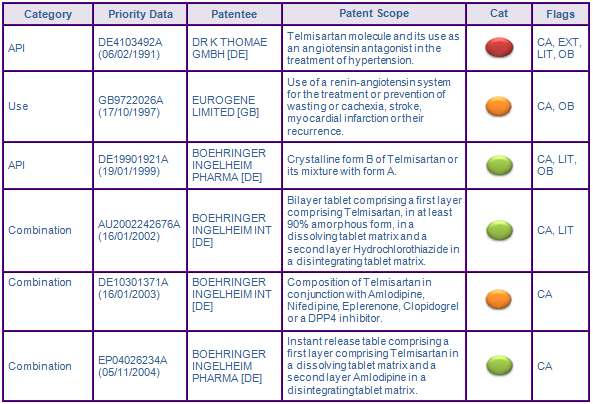
Figure 3: Patent Family View priority application DE4103492A
Amongst the US approvals, Watson is the only company to have obtained tentative market approvals for all dosage strengths for the Telmisartan tablets and the fixed dose combination of Telmisartan and HCTZ. Lupin has gained a tentative approval for the Telmisartan and Amlodipine fixed dose combination. No generics are currently on the market in the UK due to unexpired patent protection, however several companies including Egis, Sandoz and Glenmark have obtained market authorisation for Telmisartan tablets in all dosage strengths. Actavis and Teva have obtained market authorisations via the centralised procedure. Dr Reddy’s Lab and Krka hold generic authorisations for both Telmisartan and Telmisartan-HCTZ fixed dose combination tablets. These generic approvals are suggestive of the competition Micardis® will face across Europe upon molecule patent expiry. Currently no generic Telmisartan-Amlodipine approvals have been identified in Europe. This is due to data exclusivity previsions in Europe, preventing the filing of generic market authorisation until October 2018, and a further 2 year market exclusivity period could prevent the launch of a generic equivalent until October 2020. In Canada, Mylan was one of the generic competitors to launch Telmisartan and Telmisartan-HCTZ following molecule patent expiry. This is likely to be mirrored in other territories upon expiry of the molecule patent.
Figure 4: Marketing Authorisations for products containing Telmisartan in Key Countries
 Figure 5: Top Patent Applicants
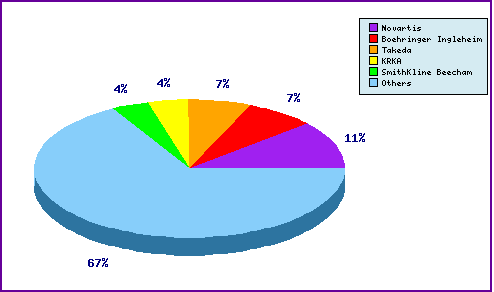
A representation of patentees who have filed the most patent families for this INN. Note the prominence of relevant applications filed by manufacturers of competing angiotensin II receptor antagonists, Novartis (Valsartan), Takeda (Azilsartan) and SmithKline Beecham (Eprosartan), who also have a stake in Telmisartan having a co-marketing arrangement with Boehringer. These represent general patents relating to the development of their angiotensin II receptor antagonists.
Figure 6: Patent Filing Trend
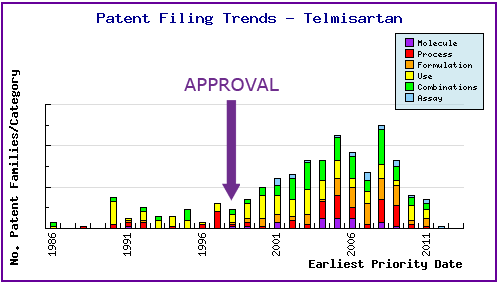
This chart represents the timing of the earliest priority filing date for each patent family identified for this molecule as well as the type of claims found in the applications. Note the strong, responsive amount of filing post-approval, particularly in the area of molecule, use and combination applications.
Figure 7: Patent Category Distribution
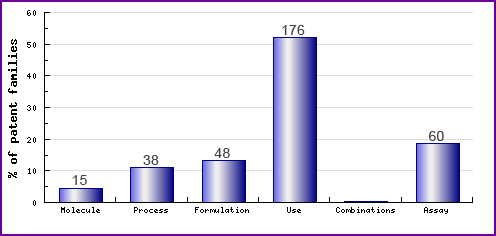
The types, number and relative distribution of patents that have been filed for Telmisartan obtained via a comprehensive patent search (Pipeline Developer report). Note the amount of filing related to the molecule, these filings comprise applications by generic companies trying to circumvent innovator patents, with the view to launch their product upon expiry of the molecule patent. The majority of ‘use’ patent filings relate to unauthorised indicated uses of Telmisartan and represent general patenting associated with the development of other innovators angiotensin II antagonists. Amongst the combination filings are patents relating to fixed dose combinations and use of combinations, and are suggestive of the attempts by generic companies to circumvent innovator patents by protecting their own Telmisartan fixed dose combinations products.
In summary, patent protection remains a significant barrier to generic entry for the Telmisartan products in most major markets due to the molecule patent being in force. Boehringer’s lifecycle management attempts to maintain a monopoly for their blockbuster drug, including combination products and extensions of indications. Patent protection for its products, apart from the molecule patent, include a ‘use’ patent and combination patents which may pose a barrier to generic competition and may see Boehringer retain some of their market share. SPCs for the Telmisartan-HCTZ combination have been the subject of litigation in France and Spain, resulting in their invalidation, a revocation proceeding is on-going in Germany. Data exclusivity provisions in Europe will prevent the launch of a generic Telmisartan-Amlodipine fixed dose combination. In Canada, generic competition for Telmisartan and Telmisartan-HCTZ entered the market shortly after the expiry of the molecule patent. This is likely to be mirrored in other territories with generic companies already holding market authorisations for both products.
Do you want find out more about how we can assist your generic drug development?
Share this article:
To register for GenericsWeb's free monthly newsletter 'INNsight', click here

 Home
Home INNform